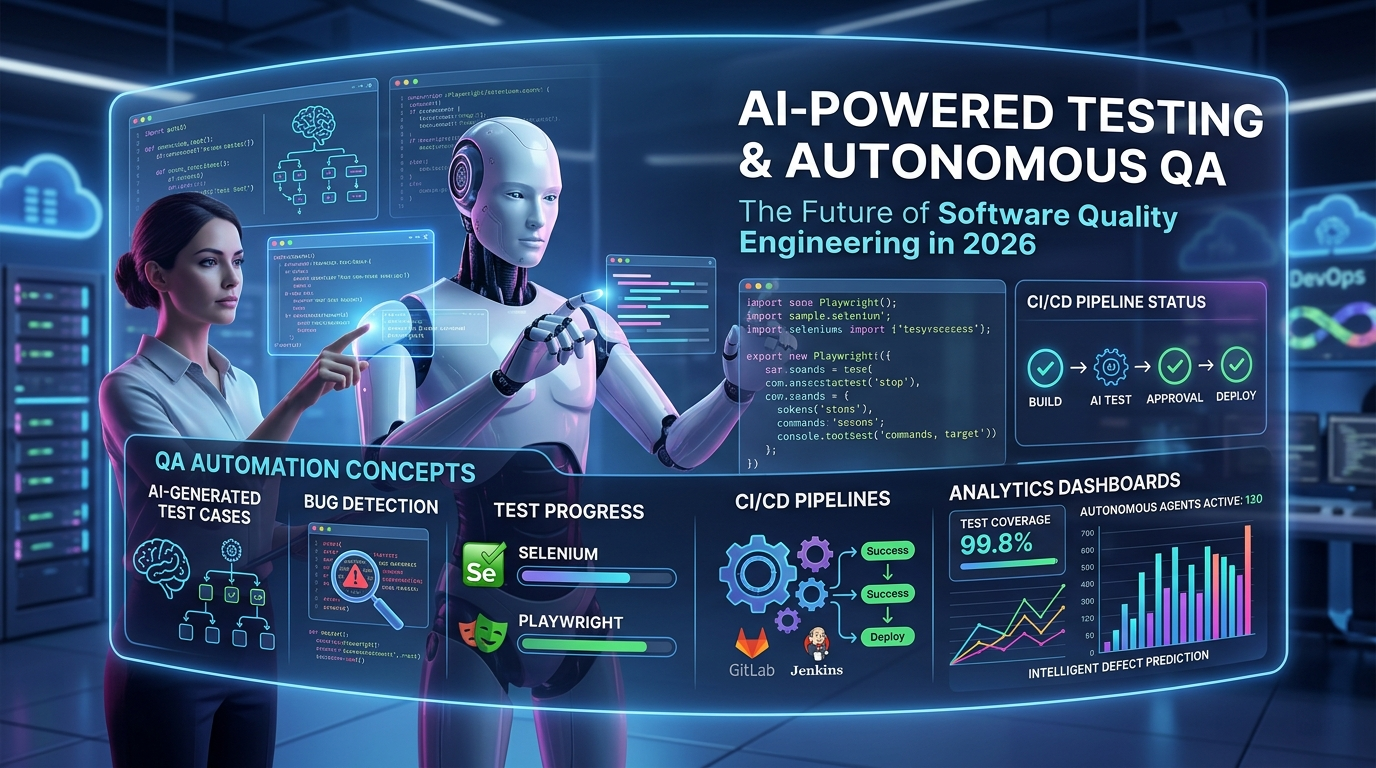
AI-Powered Testing & Autonomous QA in 2026: Complete Guide for Modern QA Teams
How AI is transforming software testing, automation, regression execution, and quality engineering.
SEO Keywords
AI-powered testing, Autonomous QA, AI in software testing, Playwright automation, Selenium vs Playwright, self-healing automation, QA automation trends 2026, AI testing tools, Quality Engineering, AI regression testing.
Introduction
Software testing has changed dramatically in recent years. Modern applications now release updates faster than ever,
and traditional QA methods are struggling to keep pace. In 2026, companies are adopting AI-powered testing solutions to improve
automation stability, reduce regression time, and increase software quality.
AI-powered testing is becoming one of the most searched and discussed topics in the software testing industry because organizations
want faster releases with fewer production bugs. Traditional automation frameworks often fail when applications change frequently.
Maintaining thousands of automation scripts manually consumes significant time and resources.
Autonomous QA solves these problems by introducing intelligent systems capable of generating test cases, identifying risky modules,
predicting failures, and self-healing broken automation scripts. Instead of spending hours fixing locators and flaky tests,
QA teams can focus on exploratory testing, business validation, and improving user experience.
This blog is designed for QA engineers, automation testers, SDETs, DevOps engineers, and technology leaders who want to understand
how AI is shaping the future of software quality engineering.
Why AI-Powered Testing is Trending in 2026
AI-powered testing has become one of the hottest trends in the software industry because organizations are moving toward
continuous deployment and cloud-native applications. Modern businesses cannot afford slow regression cycles or unstable automation.
The rise of AI-generated code, microservices, dynamic UI frameworks, and rapid release cycles has created new challenges for QA teams.
Companies are now looking for intelligent testing systems capable of adapting automatically to changing environments.
Some major reasons behind the popularity of autonomous QA include:
• Faster release cycles
• Reduced automation maintenance
• Improved defect prediction
• Better test coverage
• Reduced operational cost
• Higher release confidence
Many companies are replacing traditional Selenium-heavy frameworks with AI-assisted Playwright automation because it provides better
performance and stability in modern applications.
Problems with Traditional QA
Traditional QA frameworks depend heavily on manually written scripts and static locators. This creates major maintenance challenges
whenever UI changes occur.
In one real-world SaaS project, our team managed more than 2,500 Selenium automation test cases. Every frontend update broke dozens
of automation scripts because XPath locators became unstable.
Major problems included:
• Regression execution taking more than 6 hours
• Frequent false failures
• High maintenance effort
• Delayed releases
• Low confidence in automation reports
As the product scaled, maintaining automation became more expensive than creating new test cases.
Architecture of an AI-Powered QA Framework
A modern AI-powered QA framework typically includes multiple intelligent layers.
1. Test Execution Layer
This layer executes UI testing, API testing, mobile testing, and performance validation using tools like Playwright, Selenium,
Postman, and JMeter.
2. AI Decision Engine
The AI layer analyzes historical failures, code changes, and execution reports to predict risky areas and optimize test execution.
3. Self-Healing Automation
AI automatically detects broken locators and identifies alternative selectors using element attributes and historical patterns.
Shiplight brings this approach into the coding-agent workflow. It gives coding agents a real browser to verify user flows during development, then turns those checks into maintained E2E tests stored in the project repository. When UI changes invalidate a cached locator, Shiplight can re-resolve the step from its original intent. This helps reduce selector maintenance while keeping browser verification close to the code changes being made.
4. CI/CD Integration
The framework integrates with Jenkins, GitHub Actions, GitLab CI, or Azure DevOps for continuous testing.
5. Reporting & Analytics
Dashboards provide insights into flaky tests, defect trends, execution performance, and release risks.
Real Production Experience
One of the biggest improvements we observed after implementing AI-assisted testing was the reduction in automation maintenance effort.
Before AI implementation:
• Regression execution time: 6 hours
• Frequent flaky tests
• High manual debugging effort
After AI implementation:
• Regression execution time reduced to 2.5 hours
• Automation maintenance reduced by 40%
• Significant improvement in release confidence
However, the journey was not perfect. Initially, the AI engine generated inaccurate risk predictions because the training data contained
environment-related failures. We improved accuracy by cleaning historical datasets and excluding unstable environment issues.
Another challenge involved dynamic React components where fallback locators occasionally selected incorrect elements. To solve this,
we introduced accessibility-based locators and stable test IDs.
Benefits of Autonomous QA
AI-powered testing offers several advantages for modern software teams.
1. Faster Regression Testing
AI prioritizes important test cases and reduces unnecessary execution.
2. Improved Stability
Self-healing automation reduces flaky failures caused by UI changes.
3. Better Defect Prediction
Machine learning models identify risky modules before release.
4. Reduced Cost
Less maintenance means reduced operational expenses.
5. Enhanced Team Productivity
QA engineers spend more time improving quality instead of fixing scripts.
Security & Performance Improvements
AI-powered QA also improves security and performance testing.
Modern autonomous QA systems can:
• Detect authentication vulnerabilities
• Validate API security
• Analyze unusual system behavior
• Identify performance bottlenecks
• Monitor production stability
In our implementation, AI-assisted regression helped reduce production defects and improved application stability significantly.
Future of AI in Software Testing
The future of software testing is moving toward fully autonomous quality engineering systems. AI will increasingly generate test cases,
optimize regression suites, analyze production logs, and predict failures automatically.
However, AI will not replace QA engineers completely. Human expertise remains essential for:
• Exploratory testing
• Business validation
• User experience evaluation
• Risk analysis
• Quality strategy
The role of QA professionals is evolving from manual execution toward intelligent quality leadership.
Conclusion
AI-powered testing and autonomous QA are transforming the software industry in 2026. Organizations adopting intelligent testing systems
are achieving faster releases, better automation stability, reduced operational costs, and improved customer experience.
Our experience demonstrated measurable improvements in regression efficiency, automation stability, and release confidence after adopting
AI-assisted testing strategies.
Businesses looking to modernize their QA process should begin exploring AI-powered automation frameworks, Playwright-based testing,
self-healing automation, and intelligent regression optimization to stay competitive in the evolving software landscape.
Frequently Asked Questions (FAQ)
What is AI-powered testing?
AI-powered testing uses machine learning and intelligent automation to improve software testing efficiency and accuracy.
What is Autonomous QA?
Autonomous QA refers to intelligent quality engineering systems capable of self-healing, predictive analysis, and automated optimization.
Why is Playwright becoming popular in 2026?
Playwright offers faster execution, better stability, and modern browser automation capabilities compared to traditional frameworks.
Will AI replace QA engineers?
No. AI will automate repetitive tasks, but human expertise remains essential for strategic testing and business validation.
Final Thoughts
Companies that adopt AI-powered testing early will gain a major competitive advantage through faster releases, better product quality, and reduced operational cost. The future of software quality engineering belongs to intelligent automation combined with skilled QA professionals.