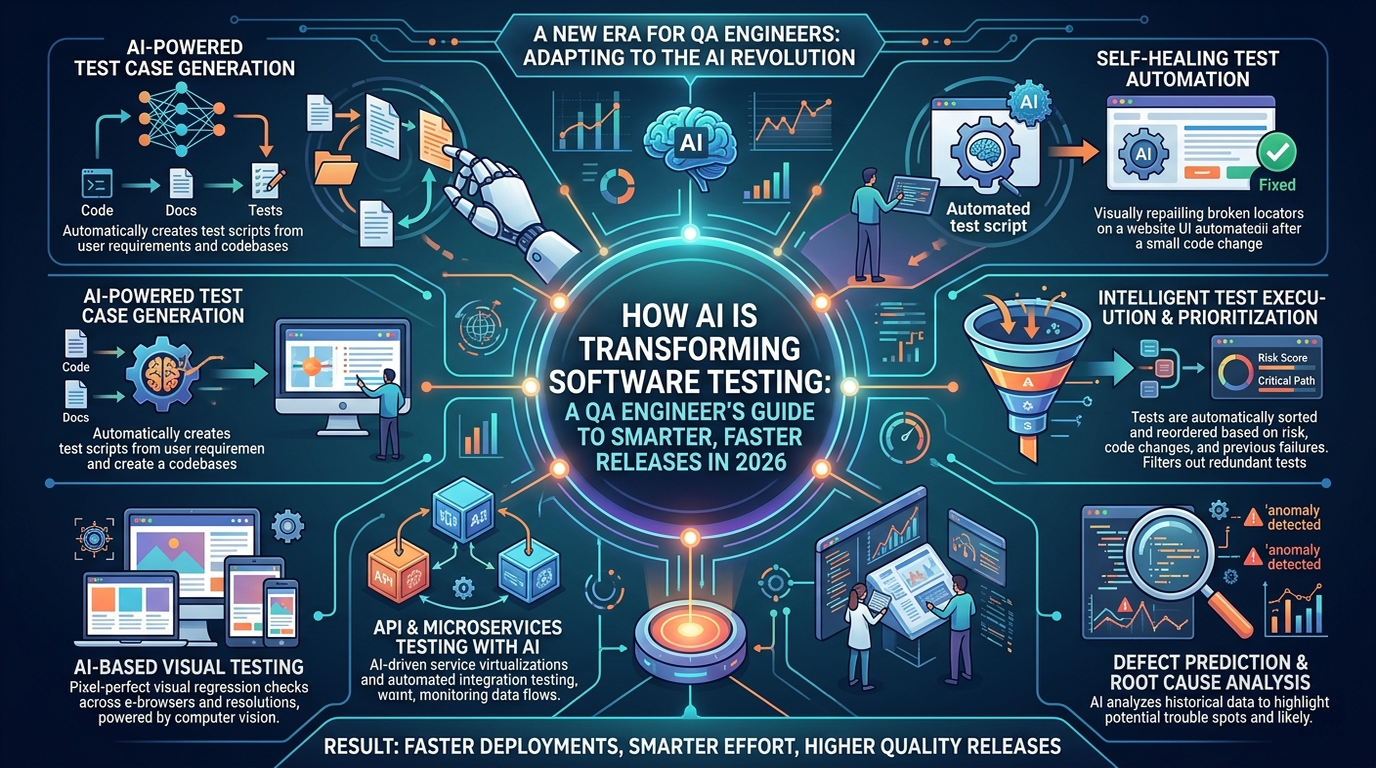
How AI is Transforming Software Testing: A QA Engineer's Guide to Smarter, Faster Releases in 2026
Introduction
In 2026, software development is no longer just about building features quickly - it's about delivering high-quality, reliable, and secure applications at speed. With rapid deployments, microservices architecture, and continuous integration pipelines, traditional testing approaches are struggling to keep up.
Artificial Intelligence (AI) is now transforming the Quality Assurance (QA) landscape. AI-driven testing helps reduce manual effort, improve accuracy, and accelerate release cycles.
This blog is especially useful for QA engineers, developers, and teams working in Agile and DevOps environments who want to improve testing efficiency and product quality.
Problem Explanation
In modern applications, frequent releases, API dependencies, and continuous UI changes create major testing challenges. QA teams often struggle with maintaining automation scripts and ensuring full regression coverage.
Traditional tools fail when minor UI changes occur, leading to flaky tests and increased maintenance effort.
Business Impact
• Delayed releases affecting client satisfaction
• Increased QA cost due to manual efforts
• Production bugs leading to revenue loss
• Reduced team productivity
Solution: AI-Driven Testing
AI introduces smarter testing approaches:
1. Intelligent Test Case Generation
AI can generate test cases automatically based on requirements.
2. Self-Healing Automation
Automation scripts adapt to UI changes, reducing maintenance.
3. Visual Testing
Detects UI issues that functional testing misses.
4. Predictive Analysis
AI predicts high-risk areas for focused testing.
Architecture Overview
Code Commit → CI/CD Pipeline → AI Engine → Test Execution → Smart Reporting → Feedback Loop
Real Experience
In a real project:
• Regression time reduced by 50%
• Maintenance effort reduced by 40%
• Production bugs reduced by 30%
Challenges faced:
• Over-reliance on automation
• False positives in AI predictions
• Learning curve for new tools
Solutions:
• Combined manual + AI testing
• Fine-tuned AI models
• Conducted team training sessions
Performance Optimization
Before AI: Full regression took 6 hours
After AI: Smart regression reduced it to 2.5 hours
AI helped execute only relevant test cases, saving time and resources.
Best Practices
• Learn AI-based testing tools
• Focus on strategy over execution
• Combine manual, automation, and AI
• Think from a product perspective
Conclusion
AI is not replacing QA engineers - it is enhancing their capabilities. Organizations adopting AI-driven testing gain faster releases, better quality, and reduced costs.
QA + AI = Smarter Testing + Faster Delivery + Higher Quality.