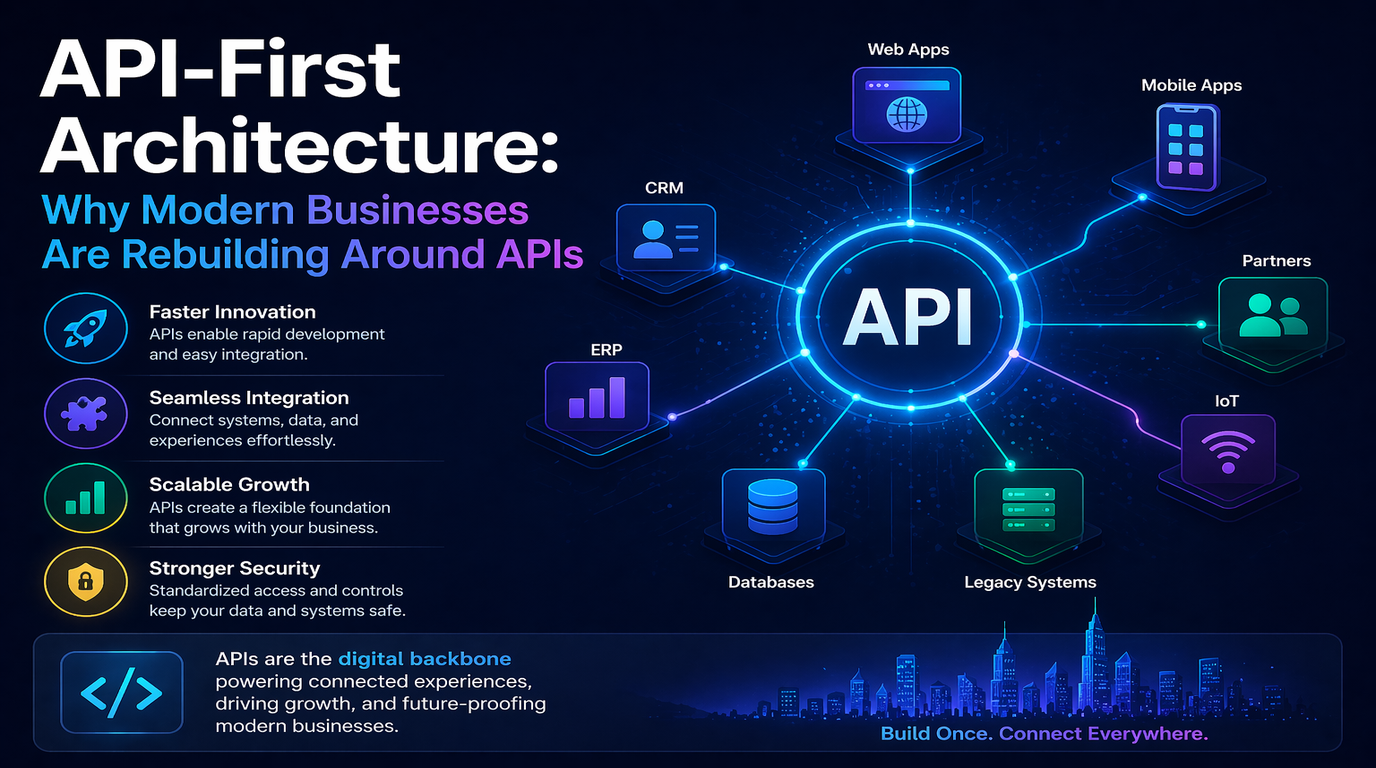
Most software teams think they have an API because they expose JSON endpoints. But there is a huge difference between having an API and being API-first. The first is an afterthought. The second is a strategy that changes how your entire business grows.
Over the last five years, the fastest-growing software companies - Stripe, Shopify, Twilio, Notion - have one thing in common. They did not start with a user interface and bolt an API on later. They built the API first and treated every interface, including their own, as just another consumer of that API.
This post explains what API-first actually means, why it matters for business growth, and how to move toward it even if you already have a product.
What API-First Actually Means
The term gets thrown around loosely, so it is worth being specific. API-first is not a technology choice. It is a design philosophy with three rules:
- The API is designed before any UI is built. Teams agree on endpoints, request formats, and response shapes in an OpenAPI spec before a single button is styled.
- Every capability is accessible through the API. If a user can do something in the app, there is an API endpoint for it. No hidden admin-only features that only the UI can touch.
- Internal apps use the same API as external partners. The company web app and the partner integration talk to the same endpoints with the same authentication. There is no secret internal API.
This flips the traditional build order on its head. In a typical project, developers build the UI first, write backend logic to support that UI, then expose some of that backend as an API if partners ask for one. The resulting API reflects UI assumptions and accumulated shortcuts. It is awkward, inconsistent, and hard to use.
In an API-first project, the contract comes first. Everything else - web app, mobile app, partner portal, Zapier integration - is built on top of it.
Why It Matters for Business Growth
The engineering benefits are well documented. The business benefits are where API-first pays for itself.
Faster time to market for new channels
When you decide to launch a mobile app, a partner portal, or a white-label version, you do not rebuild backend logic. The API is already there. You just write a new client. Teams that have done this consistently report second and third product launches taking a fraction of the time of the first.
Partner and integration revenue
A well-designed public API turns your product into a platform. Partners build on top of it, creating integrations that extend your reach into markets you would never build for yourself. Salesforce, Shopify, and Stripe all built significant parts of their revenue and competitive moat through partner ecosystems that exist only because their APIs are good enough for others to build on.
Stronger customer retention
Customers who integrate your product into their own systems via API are much harder to churn. They have invested engineering time, built workflows around your API, and embedded your product in their operations. The switching cost is no longer about features - it is about undoing an integration.
Internal velocity
When the mobile team and the web team consume the same API, they are not duplicating backend work or waiting on each other. Frontend features ship independently in parallel. The backend team ships improvements once and every client benefits.
The Shifts API-First Requires
Adopting API-first is not just a technical change. It requires rethinking how product, engineering, and business development work together. Four shifts matter most.
1. Design before you build
The API contract - endpoints, data models, authentication, error handling - is designed and reviewed before any code is written. Teams use OpenAPI specs or similar tools to agree on the contract upfront. This catches design mistakes before they are hardened into code and gives downstream teams (mobile, web, partners) something to build against while the backend is still being implemented.
2. Treat your API as a product
A public API needs the same attention as a user-facing product: accurate documentation, stable versioning, a feedback loop with the developers who use it. Companies that treat their API as an internal implementation detail - undocumented, inconsistently versioned, subject to breaking changes - do not get the partner ecosystem benefits. API-first only pays off if the API is good enough for others to build on.
3. Version from day one
APIs change as products evolve. Without a versioning strategy from the start, every change risks breaking existing integrations. Version your API from the first release. Maintain old versions for a defined deprecation window. Communicate changes proactively before they take effect.
4. Make authentication a first-class concern
API keys, OAuth flows, scopes, and rate limits are not features you bolt on later. In an API-first architecture, authentication is designed alongside the API contract. Different consumers - internal apps, third-party partners, end customers - need different permission levels. Getting this wrong early means expensive retrofits later, or worse, security gaps that erode partner trust.
Where Teams Go Wrong
Building the API after the UI
The most common mistake is treating API-first as a retrofit project. "We will build the product first, then open up the API later." By the time this happens, the backend is shaped around UI assumptions that do not translate well to a general API. The result is an API that is awkward to use, inconsistently structured, and reflects years of accumulated shortcuts.
Teams that go this route spend significantly more time cleaning up the API than they would have spent designing it correctly upfront.
Underdocumented APIs
An API without accurate documentation is barely an API. Developers evaluating whether to integrate with your platform will abandon the process quickly if documentation is incomplete, out of date, or requires reading source code to understand. Documentation is not a post-launch task - it is part of the API product.
Auto-generated docs from your OpenAPI spec are a starting point, not a finish line. Real documentation includes use-case guides, authentication walkthroughs, code examples in multiple languages, and clear explanations of every error code.
Ignoring developer experience
The people integrating your API are developers, and developers have strong opinions about what makes an API pleasant or painful to work with. Small issues compound fast:
- Inconsistent naming: if one endpoint returns
customer_idand another returnscustomerId, you have already lost people - Cryptic errors: error responses should tell developers exactly what went wrong and how to fix it
- No sandbox environment: developers should be able to test integrations without touching production data
- Missing rate limit headers: always tell developers how close they are to their limit, not just when they have hit it
How to Start Without a Full Rebuild
For businesses with existing products, API-first does not require throwing everything away. The path forward is incremental.
Step 1: Audit what you have
Map every capability your product offers. Identify which ones are most requested by partners or customers for integrations. These become the first endpoints in your public API.
Step 2: Design the ideal contract
For each capability, design the API as if you were building it fresh: clean data models, consistent naming, logical resource structure. Do not expose your internal data model directly. Build an abstraction layer that translates between your internal logic and the clean external interface.
Step 3: Ship a v1 with limited scope
Resist the urge to expose everything at once. A smaller, well-designed API that developers can trust is more valuable than a large, inconsistent one. Ship the highest-value endpoints, document them thoroughly, and gather feedback before expanding.
Step 4: Build internal products on the same API
The fastest way to validate your API design is to make your own teams use it. If the mobile team is building on top of the same public API, they will surface design problems quickly and fix them before external developers hit them.
The Compounding Advantage
Businesses that moved to API-first five years ago are not just better integrated today. They have infrastructure that compounds. Every new partner integration makes the platform more valuable. Every customer who builds on the API deepens their commitment. Every internal team that ships faster because the API exists creates capacity for new products.
The shift is not painless. It requires design discipline upfront, investment in documentation and developer experience, and a willingness to treat the API as a product rather than plumbing. But for businesses that make that investment, the returns show up in growth metrics, retention numbers, and partner relationships that competitors cannot replicate quickly.
The Bottom Line
API-first is not a technical trend. It is a growth strategy. The companies building the most durable competitive advantages in software right now are not just shipping better features. They are building better platforms. And every platform starts with an API.
If your product has plateaued and partnerships feel harder than they should, the problem might not be your features - it might be your architecture. At Logic Providers, we help teams design API contracts, migrate existing products to API-first, and ship public APIs that developers actually want to build on.