In the age of artificial intelligence, businesses face a critical dilemma: they recognize the transformative potential of AI but are daunted by the prospect of building and training their own models. The traditional path - assembling a team of data scientists, collecting massive datasets, investing in expensive GPU infrastructure, and spending months on training - is simply out of reach for most organizations.
But here is the good news: AI is no longer an exclusive technology reserved for large corporations with massive R&D budgets. Today, businesses of all sizes can access AI-powered solutions at a fraction of the cost, thanks to cloud-based AI services and flexible pay-as-you-go models. You do not need to build your own AI model to harness its power.
The Traditional AI Challenge
Building a custom AI model from scratch is an enormous undertaking. Companies typically need to:
- Hire specialized talent: Machine learning engineers and data scientists command premium salaries and are in short supply
- Gather massive datasets: Training effective models requires millions of data points
- Invest in infrastructure: GPUs and specialized hardware cost hundreds of thousands of dollars
- Wait months for results: Model training and fine-tuning is a time-intensive process
- Maintain and update continuously: Models degrade over time and need constant refinement
For a mid-sized business, this could easily translate to a multi-million dollar investment with uncertain returns. Even tech giants with deep pockets struggle with these challenges.
The Smarter Approach: Knowledge Base Architecture
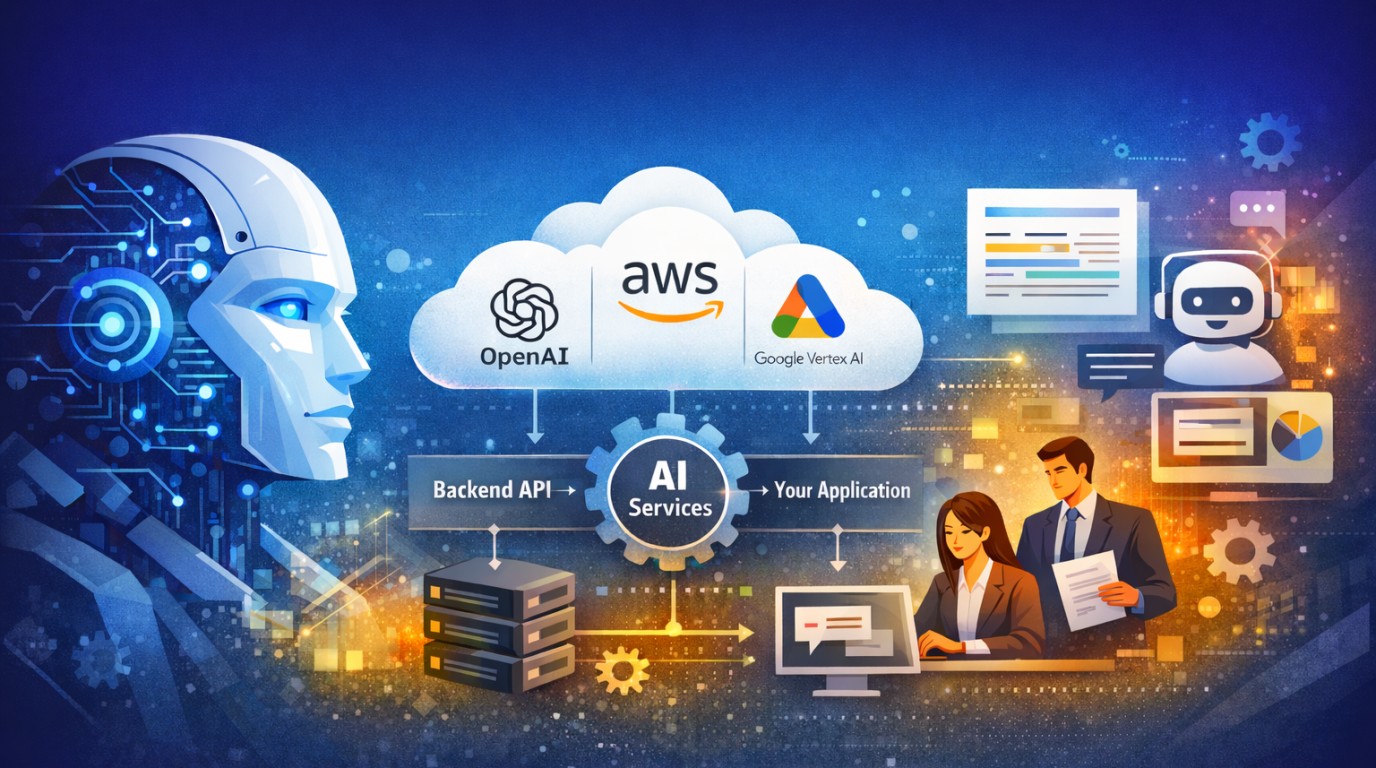
There is a smarter approach: leverage pre-trained foundation models (like Claude, GPT, or Llama) and customize them with your private business data through a knowledge base architecture. Instead of training a model, you are teaching an existing model about your specific business context.
Step 1: Store Your Private Data
Take your business documents - customer records, product catalogs, order histories, policies, procedures, technical documentation - and store them in a structured format in cloud storage like Amazon S3. This could be markdown files, PDFs, or JSON documents containing your proprietary information. The key is making your data searchable and well-structured so the AI can understand the context.
Step 2: Create a Searchable Knowledge Base
Using AWS Bedrock's Knowledge Base service, connect your S3 storage to a vector database that indexes your documents. This ingestion process converts your text into mathematical representations (embeddings) that AI models can search through semantically.
When a document is uploaded or updated, the ingestion job automatically processes it, making it instantly searchable. Update a file in S3, trigger an ingestion job, and within minutes your AI assistant knows about the changes - no retraining required.
Step 3: Query with Context
When users ask questions, your application follows a retrieve-and-generate pattern:
- Retrieval: The system searches your knowledge base for relevant documents matching the query
- Context building: It gathers the most relevant excerpts from your private data
- Generation: It sends the query along with this context to a foundation model like Claude or GPT
- Response: The model generates an answer grounded in your specific business data
This happens in milliseconds. The AI can answer questions about specific orders, cite company policies, reference technical specifications, or provide customer-specific information - all while maintaining the privacy and security of your data within your own AWS infrastructure.
Key Benefits of This Approach
- Speed to Market: Deploy AI capabilities in weeks, not years. No model training cycles.
- Cost Effectiveness: Pay only for what you use. Foundation model pricing is consumption-based, and storage costs are minimal compared to training infrastructure.
- No ML Expertise Required: Developers familiar with APIs and cloud storage can implement this. You do not need PhDs in machine learning on staff.
- Data Privacy: Your proprietary data never leaves your AWS account. The foundation model processes queries but does not retain your business information.
- Easy Updates: Change your data, run an ingestion job, and you are done. No retraining, no deployment cycles, no downtime.
- Scalability: Start small with a few hundred documents and scale to millions without architectural changes.
- Flexibility: Switch between different foundation models (Claude, GPT-4, Llama) without rebuilding your system.
Getting Started
If you are considering AI for your business, start by identifying a use case where context matters:
- Customer service that needs to reference your specific products and policies
- Internal knowledge management across documentation and procedures
- Specialized assistance for employees handling complex workflows
- Automated analysis of your business documents and records
Then ask yourself: do we have this information in digital form? Can we structure it reasonably well? If yes, you are ready to implement a knowledge base approach.
The era of accessible AI is here. You do not need a massive budget or an army of data scientists. You need a clear use case, organized data, and the willingness to leverage existing technology smartly. The foundation models are already built - your job is simply to teach them about your business.