I've had this debate more times than I can count. A developer joins the project, looks at the auth setup, and immediately asks - "Why are we using JWT here and not OAuth2?" Or the reverse. The honest answer is: most teams pick one because they've heard of it, not because they actually thought through the tradeoff.
In 2026, that kind of guesswork is expensive. APIs are not just internal plumbing anymore - they are the product. A compromised authentication layer means data leaks, regulatory headaches, customer churn. And the worst part? Most auth vulnerabilities in production were not exotic zero-days. They were basic design mistakes made early in the project that nobody had the time to revisit.
The Problem Nobody Talks About
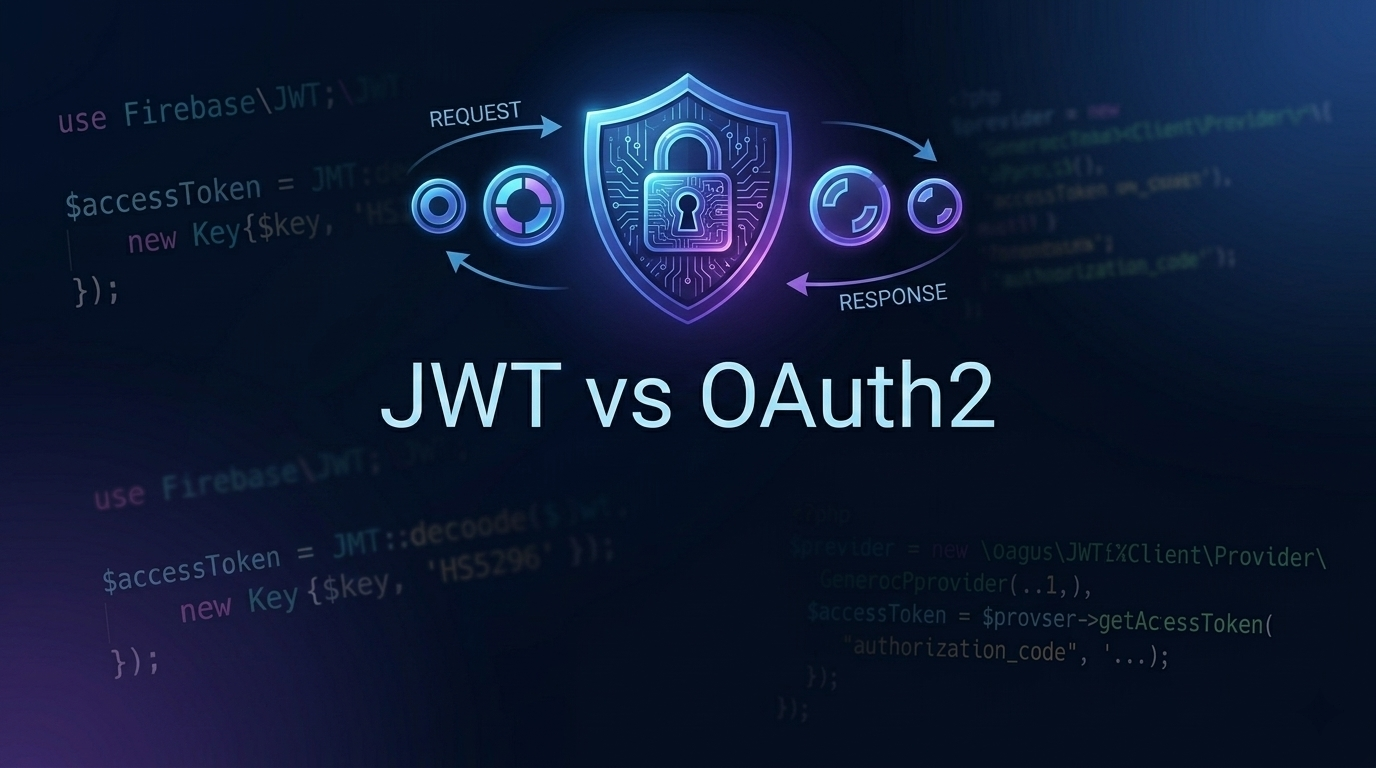
Here is the thing most comparison articles get wrong - JWT and OAuth2 are not really competing solutions to the same problem. JWT is a token format. OAuth2 is an authorization framework. Comparing them directly is a bit like asking whether you should use JSON or REST. They operate at different levels.
A client came to us mid-project, about eight months into building a multi-tenant SaaS platform. They had used JWT everywhere. Then one of their integration partners reported suspicious activity. A partner's credentials had been compromised, and someone was using their JWT access token to hit the API. The token was valid for 24 hours. There was no way to revoke it.
That single architectural choice - long-lived JWTs with no revocation path - turned a recoverable incident into a full security response. Their CTO called it the most expensive copy-paste decision the team ever made.
How Each One Actually Works
JWT in Plain Terms
A JWT is three base64-encoded strings joined by dots: a header, a payload, and a signature. The header says what signing algorithm was used. The payload carries your claims - user ID, roles, expiry, whatever you put in there. The signature lets any service with the right key verify the token is legitimate without calling home.
That last part is the whole value proposition. No database round-trip on every API call. For a PHP microservices setup handling thousands of requests per second, that matters.
Key practices for safe JWT usage:
- Use 15-minute expiry - not 24 hours
- Include a
jti(JWT ID) claim for revocation support - Use RS256 (asymmetric), not HS256 (symmetric), if multiple services need to verify
OAuth2 in Plain Terms
OAuth2 is a framework that answers a specific question: how do you let a third-party application access a user's data without giving it the user's password? It does this through a series of redirects, tokens, and defined scopes. The user consents. The authorization server issues tokens. The client uses those tokens. Nobody shares credentials directly.
The most common grant types in PHP applications are the Authorization Code Grant (for web and mobile apps acting on behalf of users) and the Client Credentials Grant (for server-to-server calls where there is no human user involved). Key advantage: tokens can be revoked immediately - no waiting, no exposure windows.
So Which One Should You Use?
The short version: if you are building internal APIs or a straightforward mobile backend where you control all the clients, JWT with short expiry and a Redis blocklist is lean and effective. If you have third-party integrations, partner APIs, or social login, you need OAuth2. And if you are building a large multi-tenant SaaS platform - you probably need both, with JWT as the access token format inside an OAuth2 flow.
What We've Actually Learned in Production
The Revocation Problem - And How We Fixed It
Every JWT we issue now includes a jti (JWT ID) claim. When we need to invalidate a token (logout, password change, suspicious activity), we write the jti to Redis with a TTL matching the token's remaining lifetime. Every request checks Redis before proceeding. One round-trip, under a millisecond, and the token is dead the moment we say it is.
Switching from HS256 to RS256
We spent about two years using HS256 across a microservices project. HS256 is symmetric - the same secret that signs the token also verifies it. That means every service that needs to verify JWTs needs a copy of your signing secret. Distributing and rotating that secret across 12 services is genuinely painful.
Moving to RS256 fixed this cleanly. The auth service holds the private key and signs tokens. Every other service gets a public key via a JWKS endpoint and uses it to verify. No shared secrets. The measurable result: our next security audit flagged zero key management issues, compared to three on the previous audit.
The OAuth2 Scope Sprawl Problem
When you are moving fast, it is tempting to reuse existing OAuth2 scopes rather than define new ones. One scope ends up covering more and more functionality. We now treat scope definition like schema design - it is a deliberate upfront decision, not an afterthought. Scopes are narrow, specific, and documented.
Token Storage on the Client
I have reviewed a lot of PHP backends where the token strategy was solid - and then the frontend was storing JWTs in localStorage. That is roughly equivalent to putting a great lock on your door and leaving the key under the mat. Any XSS vulnerability in your frontend can read localStorage.
HttpOnly, Secure cookies are meaningfully better. The combination of short token expiry, HttpOnly cookies, and refresh token rotation is the setup we standardise on for browser-based clients.
Wrapping Up
JWT and OAuth2 are both good tools. The question is whether you are using them for the right job. JWT is fast, stateless, and simple to implement - but it needs guardrails (short expiry, RS256, a revocation mechanism) to be safe in production. OAuth2 is more complex but purpose-built for scenarios involving third-party access and granular permissions.
The biggest mistake teams make is not picking the "wrong" one - it is picking one without thinking about what they are actually trying to solve, and then discovering the gap six months later when something breaks in production.
If you are starting a new PHP project, take an hour to map your authentication scenarios before you write a line of code. Who are your clients - your own apps, third parties, or both? Do you need instant revocation? Will you ever have partners accessing user data on their behalf? The answers will tell you what you need.