Every small business has the same quiet leak: the phone rings while everyone is busy, nobody picks up, and the caller dials the next business on the list. A dental clinic in the middle of a procedure, a salon with every chair full, a realtor driving between showings, a restaurant during the dinner rush. The call goes to voicemail, and most people never leave one.
AI voice receptionists promise to close that leak. They answer every call, at any hour, in a natural-sounding voice, and they can book appointments, answer questions and take messages. A couple of years ago the honest answer to "can AI answer my phone?" was "not well". In 2026 the answer is more interesting: yes, for a specific set of calls, if you set it up properly. This article is about where that line sits.
What an AI Voice Receptionist Actually Is
Forget the old phone trees that made you "press 1 for sales". A modern AI receptionist is a pipeline of four parts working together in real time:
- Telephony - your business number forwards calls to the AI, either for every call or only when nobody answers.
- Speech-to-text - the caller's voice is transcribed as they speak.
- A language model - the "brain" understands what the caller wants and decides what to say or do next, using information about your business that you provide.
- Text-to-speech - the reply is spoken back in a natural voice, fast enough to feel like a conversation.
The part that makes it genuinely useful is the fifth piece: integrations. A receptionist that can only talk is a fancy voicemail. One that can check your calendar, book the slot, create a lead in your CRM, and text the caller a confirmation is doing real work. This is the same idea behind connecting AI to your business systems - the voice is just the front door.
What They Handle Well
AI receptionists are strongest on calls that are frequent, predictable and low-risk. For most local businesses, that is the majority of the phone volume.
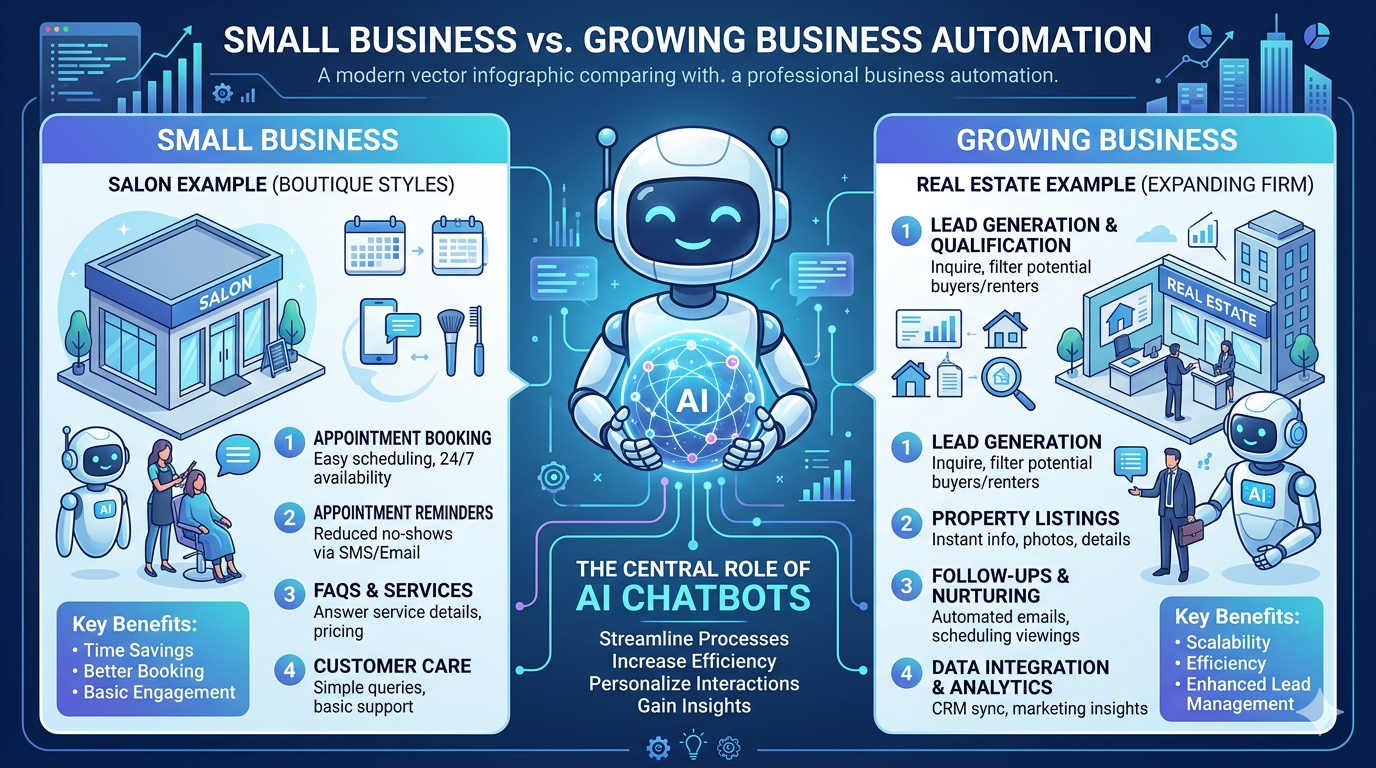
- Booking, rescheduling and cancelling appointments - especially when connected directly to your booking system.
- Answering the same ten questions - hours, location, parking, pricing ranges, which services you offer, whether you take a particular insurance.
- Capturing leads - name, number, what they need, how urgent it is, and sending it straight to your team.
- After-hours and overflow calls - the calls that would otherwise go to voicemail and be lost.
- Routing - working out who the caller needs and transferring them, instead of making them listen to a menu.
- Multiple languages - many systems can switch language mid-call, which matters a lot in multilingual cities.
The real advantage is not that the AI is a better receptionist than a good human. It is that it is always available, never puts anyone on hold, and never has a bad day. It picks up the third call at 9:02 on a Monday morning just as well as the first.
Where They Still Fall Short
Here is the part the vendor demos tend to skip. AI receptionists still struggle in predictable ways, and you should plan for them before a customer finds them for you.
Emotional or sensitive calls
An upset customer, a complaint, a patient in pain, a family emergency. These calls need empathy and judgement, not efficiency. A good setup detects them and hands off to a human quickly. A bad setup keeps cheerfully offering appointment slots.
Confident wrong answers
Language models can make things up. If the AI does not know your cancellation policy, it may invent a reasonable-sounding one. The fix is strict: give it a clear knowledge base, tell it to say "I will have someone confirm that" when it is not sure, and never let it quote prices or policies it has not been given.
Noise, accents and bad connections
Speech recognition is very good now, but a caller on speakerphone on a busy road will still trip it up sometimes. The AI needs to confirm important details - names, phone numbers, dates - by reading them back, the same way a careful human would.
Unusual or complex requests
"Can you do a custom quote for three properties with different timelines?" is not a receptionist call, AI or human. The goal is not for the AI to handle everything; it is for it to recognise what it should not handle and pass it on cleanly.
Callers who simply want a human
Some people will ask for a person within the first five seconds. Let them. Trapping a caller with an AI that refuses to transfer is the fastest way to lose the trust you were trying to build.
The rule of thumb: an AI receptionist should be judged less on how many calls it handles alone and more on how gracefully it hands off the ones it should not.
What It Actually Costs
Most AI voice platforms charge per minute of conversation, sometimes with a monthly base fee, plus your phone number and any integration work. For a typical small business, the running cost usually lands well below the cost of a part-time receptionist - but the price tag is the wrong place to start.
The better question is: what is a missed call worth to you? Look at your phone logs for a month and count the unanswered calls. Multiply by how often a caller becomes a customer, and by what a customer is worth. For a dental clinic, a law firm or a renovation company, a handful of recovered calls a month can cover the whole system. For a business that rarely misses calls, the case is much weaker.
Also budget for the setup, which is where most of the value is made or lost: writing the knowledge base, connecting the calendar and CRM, defining the handoff rules, and testing it with real call scenarios before it goes live.
Which Businesses Benefit Most
AI receptionists make the most sense where calls are frequent, the questions repeat, and every missed call is a missed booking:
- Dental and medical clinics - appointment booking, reminders and after-hours calls, with anything clinical handed to staff.
- Salons, spas and nail studios - the team is hands-on with clients and cannot stop to answer the phone.
- Realtors and mortgage brokers - speed matters; the first agent to respond to a lead often wins it.
- Restaurants - reservations, hours and takeout questions during the busiest hours.
- Law firms and immigration consultants - qualifying new enquiries and booking consultations, while anything that sounds like legal advice goes to a person.
- Home services and trades - the owner is on a job site, and the caller wants a quote today.
Privacy and Disclosure: Do Not Skip This
An AI receptionist records and transcribes conversations, and often collects personal information. That brings real obligations.
- Tell callers they are speaking with an AI. It is the honest thing to do, it is increasingly expected, and it avoids the trust damage of a caller discovering it halfway through.
- Tell callers the call may be recorded, and why.
- Know where the data goes. For Canadian businesses, privacy laws such as PIPEDA, and Quebec's Law 25 if you serve Quebec residents, set rules on how personal information is collected, stored and shared. Ask the vendor where recordings and transcripts are stored, for how long, and whether they are used to train models.
- Be extra careful with health, legal and financial details. Keep the AI's job narrow - book the appointment, do not collect the medical history.
This is not legal advice, and the rules differ by province and industry, so check your specific obligations before you go live.
How to Roll One Out Without Annoying Your Customers
The businesses that get good results do not flip a switch and hand over the whole phone line. They start narrow and expand as the system earns trust.
1. Start with after-hours and overflow
Let the AI answer only when nobody else can. You recover calls you were losing anyway, and your existing customers still reach the people they know during the day.
2. Give it a short, accurate script and knowledge base
Write down your real answers to the questions callers actually ask. Short and accurate beats long and vague. Anything not in the knowledge base should trigger "let me have someone get back to you".
3. Define the handoff rules clearly
Decide in advance when the AI must transfer or take a message: the caller asks for a person, sounds upset, mentions an emergency, or asks about something outside its scope. Make sure the message actually reaches someone, with a transcript attached.
4. Connect it to your real systems
A receptionist that books directly into your calendar and logs the lead in your CRM saves your team time. One that only takes messages just moves the work around.
5. Read the transcripts every week at first
Transcripts are the best feedback you will ever get on your phone experience. You will spot the questions you forgot to cover, the places it hesitated, and the moments a caller got frustrated. Fix them, and the system gets noticeably better within a few weeks.
6. Measure what matters
Track answered calls, bookings made, successful handoffs, and how many callers hung up early. Those numbers tell you whether it is working far better than a vendor's accuracy claims.
Questions to Ask Any Vendor
- How fast does it respond? Long pauses make callers talk over the AI and hang up.
- Can callers interrupt it naturally, or does it talk over them?
- Which calendars, CRMs and booking systems does it connect to?
- How does it transfer to a human, and what happens if nobody picks up?
- Where are recordings and transcripts stored, and can we delete them?
- Can we see and edit exactly what it is allowed to say?
- What happens to our phone number if we leave?
So, Can They Really Answer Your Business Phone?
Yes - for the calls that make up most of your volume, and if you set clear limits. An AI voice receptionist is excellent at booking, answering routine questions, capturing leads and making sure no caller ever hits voicemail at 7 p.m. It is not a replacement for a person on the calls that need judgement, empathy or expertise, and it should never pretend to be.
The winning setup is not AI instead of people. It is AI handling the repetitive calls so your people can give their full attention to the ones that matter. Start with after-hours, read the transcripts, and expand only as far as the results justify.
Key takeaway: Judge an AI receptionist by the calls it recovers and the handoffs it gets right, not by how human it sounds. Start narrow, keep it honest with callers, and connect it to your real systems so it does real work.
At Logic Providers, we design and build AI voice and chat assistants that connect to the tools you already use - your calendar, CRM and booking system - with clear handoff rules and privacy built in. If you want to know whether an AI receptionist would actually pay off for your business, our custom AI assistant and workflow automation teams are happy to look at your call volume and give you an honest answer.