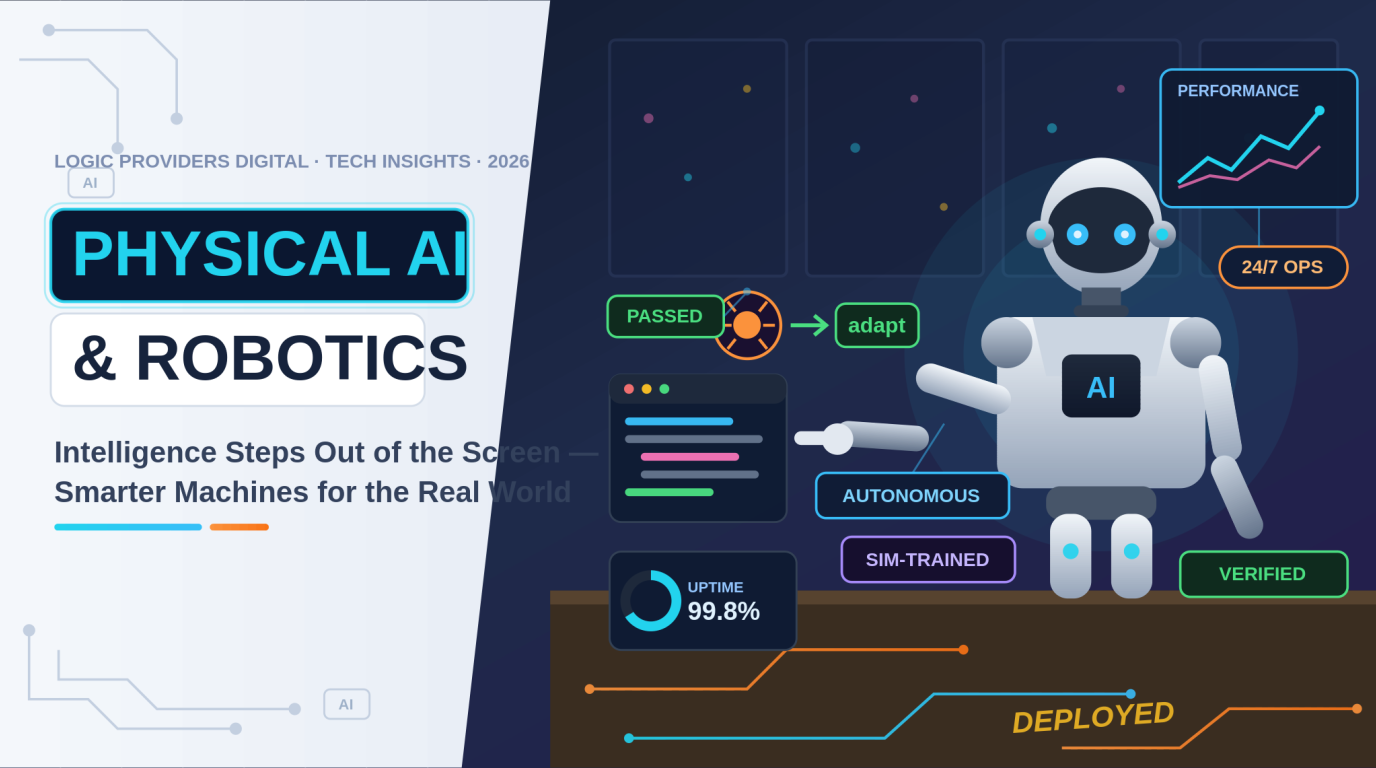
For the past few years, artificial intelligence has lived behind glass. It wrote our emails, generated our images, answered our questions, and analyzed our spreadsheets - all within the safe, forgiving world of pixels. In 2026, that era is ending. Intelligence is stepping out of the screen and into the physical world, and the industry has a name for it: Physical AI.
At CES earlier this year, NVIDIA CEO Jensen Huang declared that the "ChatGPT moment for physical AI is here." Boston Dynamics unveiled a production-ready Atlas humanoid built for material handling and order fulfillment. Hyundai announced plans to deploy humanoids across its factories, while Audi and BMW are running their own pilots. What was a research curiosity two years ago is now a procurement line item.
What Exactly Is Physical AI?
Physical AI refers to AI systems that allow machines to perceive, understand, reason about, and act within the real world in real time. The simplest way to grasp the difference: generative AI predicts the next word in a sentence, while physical AI predicts the next physical movement in a dynamic environment. It is the difference between a model that can describe how to lift a box and a robot that can actually lift one - without crushing it, dropping it, or knocking over the shelf beside it.
Traditional industrial robots have been around for decades, but they were essentially fast, precise playback machines. They executed pre-programmed motions in fenced-off cells, and any deviation in their environment - a misaligned part, an unexpected obstacle, a human walking by - broke the routine. Physical AI systems are fundamentally different. They combine three capabilities that older automation never had: perception (understanding their surroundings through cameras, LiDAR, and force sensors), reasoning (planning actions and anticipating physical consequences), and adaptation (learning from experience rather than following fixed scripts).
Why 2026 Is the Inflection Point
Several forces converged to make this the breakout year rather than another hype cycle.
The technology stack matured. Vision-Language-Action (VLA) models - the physical-world cousins of large language models - can now translate camera input and natural-language instructions directly into motor commands. Layered architectures pair an embodied-reasoning model for high-level planning with a VLA model for perception and execution, giving robots something resembling genuine situational judgment.
Simulation changed the economics of training. Platforms like NVIDIA Isaac and Omniverse let robots train themselves across millions of virtual scenarios before ever touching the real world. This "simulate-then-procure" approach also transformed buying decisions: manufacturers now build and validate an entire robotic work cell in a digital twin before spending a single dollar on hardware.
Labor economics forced the issue. Persistent labor shortages, rising wage costs, and increasingly variable production requirements have left manufacturers with gaps that traditional automation cannot fill. Robots that handle changeovers, unstructured environments, and dexterous manipulation are no longer a nice-to-have - they are the only scalable answer many operations have left.
The money arrived. The physical AI market is projected to grow from roughly $1.5 billion in 2026 to over $15 billion by 2032 - a compound annual growth rate above 47 percent. Analysts estimate the broader impact on industrial productivity could exceed $3 trillion by 2040. Hardware suppliers are already feeling it: chip-test leader Teradyne reported an 87 percent year-over-year revenue jump in Q1 2026, driven largely by AI-related demand, and warehouse robotics firm Symbotic grew revenue 23 percent with seventy automated systems now deployed.
Where Physical AI Is Working Today
The most visible frontier is humanoid robots, but the quiet revolution is broader. In logistics, AI-powered systems now perform complex pick, stow, and touch operations at commercial scale, and investment is spreading from warehouses into retail. In manufacturing, autonomous welding, sanding, and inspection systems built on task-specific AI are cutting rework and delivering quality from day one. Agility Robotics recently partnered with Toyota's Canadian manufacturing arm to deploy its Digit humanoid, while surgical robotics, power-grid inspection drones, and autonomous delivery vehicles extend the same underlying technology into healthcare, energy, and urban environments.
An interesting shift is also happening in how robots work together. Fleet orchestration and imitation learning are turning isolated machines into cooperative teams - one robot demonstrating a task while others learn to follow its pace. Factories are experimenting with robotic "night shifts," where humans set up automated cells at the end of the day and let them run unattended until morning.
The Honest Challenges
It would be dishonest to write about physical AI without acknowledging the uncertainty. Analyst forecasts for the humanoid market by 2030 range wildly - from under one million annual units to more than six million. If the optimistic projections fail to materialize, the sector risks becoming one of the largest misallocations of industrial capital in recent memory.
The practical hurdles are real. Human-like dexterity and pressure control remain unsolved at production quality. Unplanned downtime in a factory costs millions, so reliability standards for physical AI are far stricter than for a chatbot that occasionally hallucinates. And as factories become more connected, cybersecurity becomes a physical-safety issue, not just a data issue. The consensus among practitioners is that adoption will be fast, but the journey from impressive demo to fully dependable deployment will be slower than the keynote videos suggest.
What This Means for Software Teams and Businesses
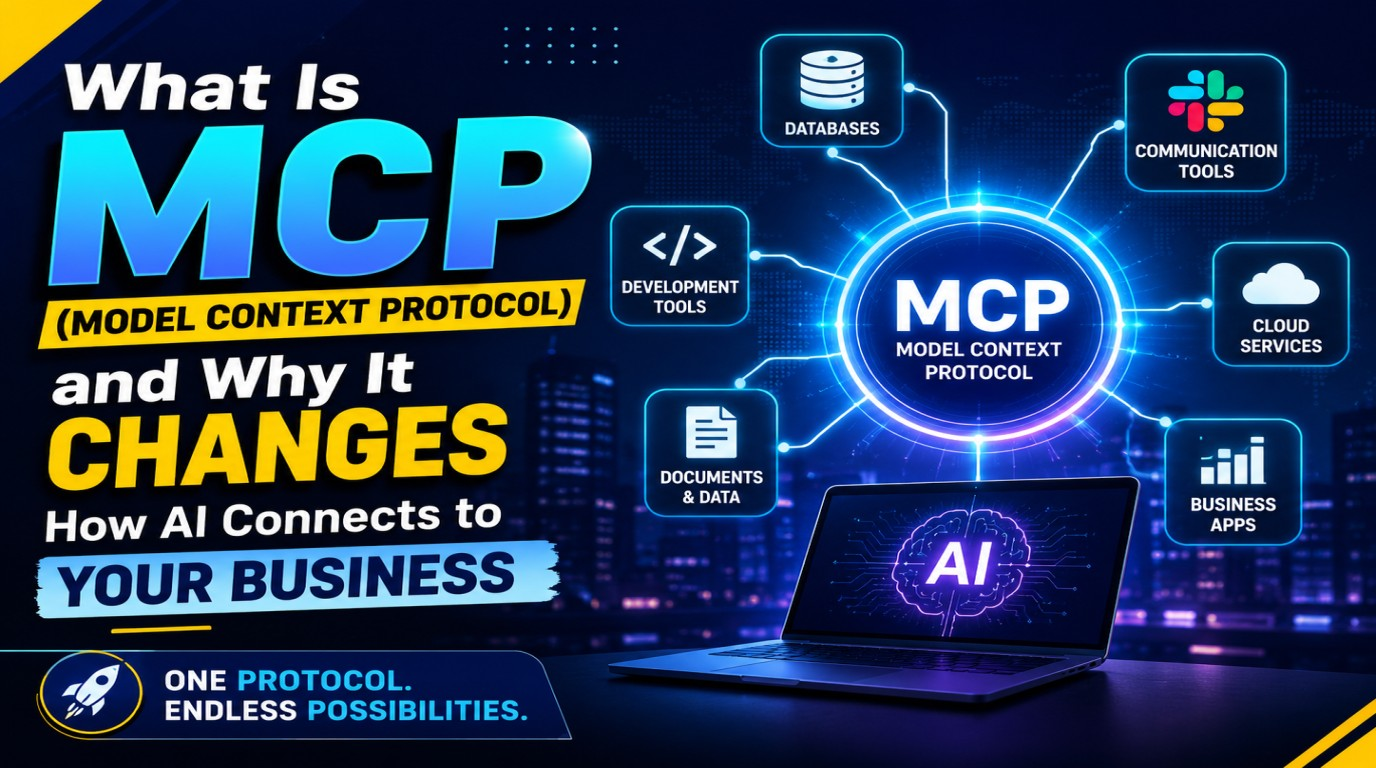
Here is the part that matters even if you never plan to buy a robot: physical AI is fundamentally a software and data problem wearing a hardware costume. Every deployment needs cloud infrastructure, edge computing pipelines, real-time dashboards, fleet-management APIs, simulation environments, and integration with existing ERP and warehouse systems. You cannot plug a 2026 humanoid into a 1990s spreadsheet - companies adopting these systems need what analysts call a "digital nervous system," a unified data platform orchestrating machines, sensors, and business logic. In practice, that connective layer looks a lot like the standardized way AI now plugs into business tools, which we explored in our guide to MCP.
A new data economy is also emerging around robotics. The sensor readings, vision frames, and force profiles that deployed robots generate are becoming valuable training assets, creating a virtuous cycle where every robot in the field makes the next generation smarter - and creating demand for privacy-preserving data pipelines to handle it responsibly.
For businesses evaluating the space, the disciplined playbook looks like this:
- Start with well-bounded, high-frequency tasks where reliability is provable.
- Validate ROI in simulation before purchasing hardware.
- Invest in the data and integration layer first - it is the foundation every future robot will stand on.
The Bottom Line
For decades, we taught computers to think. Now we are teaching them to do. The migration of intelligence from the world of bits to the world of atoms is the defining technology story of 2026, and like every platform shift before it, the winners will not just be the companies building the robots - they will be the ones building the software, data infrastructure, and integrations that make robots useful. This is the physical-world counterpart to the same shift reshaping the tech industry's foundations, which we covered in from software advantage to infrastructure control.
The machines are stepping off the screen. The question for every business is no longer whether to pay attention, but how fast.
Logic Providers helps businesses design, build, and integrate AI-powered systems - from cloud infrastructure and real-time dashboards to intelligent automation. Get in touch to explore what physical AI readiness looks like for your operations.