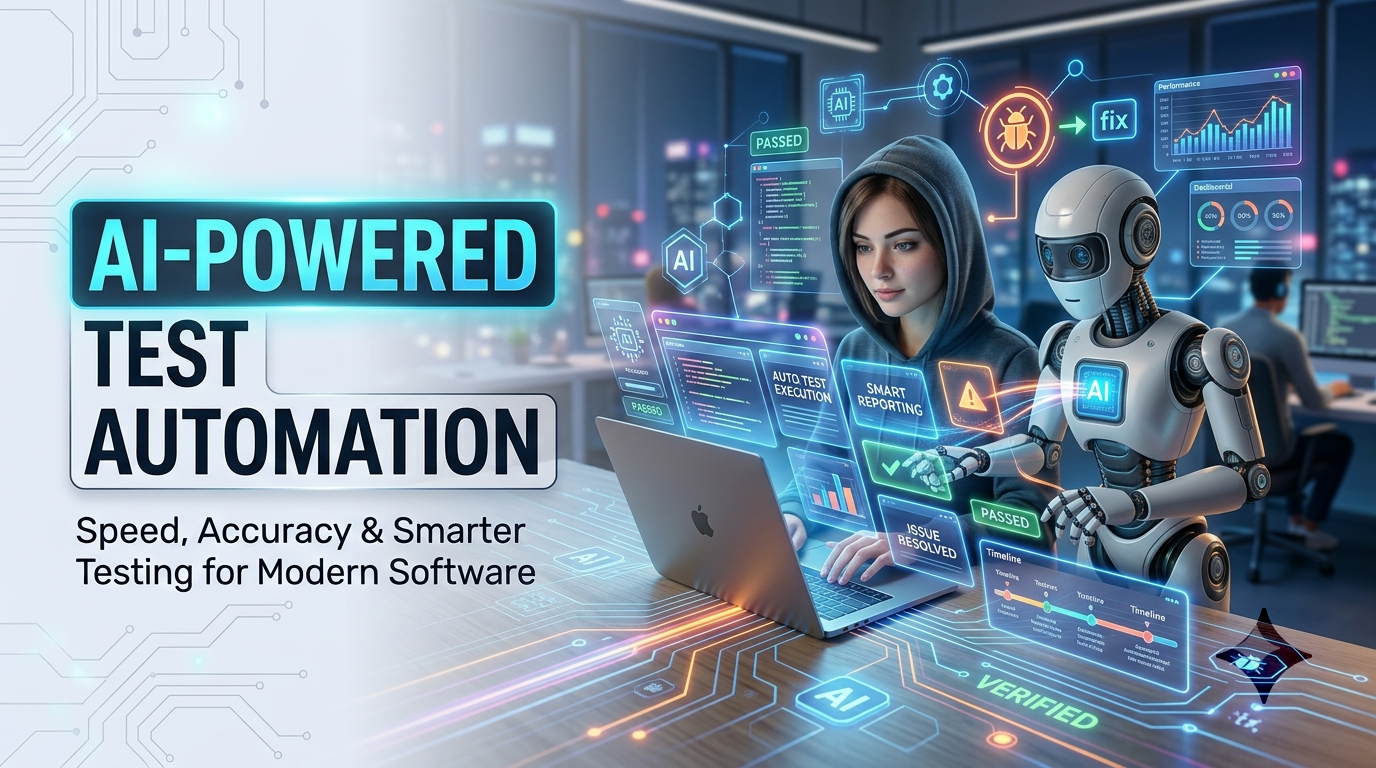
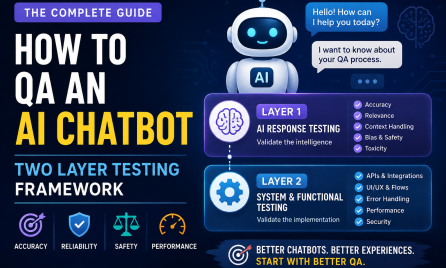
Software delivery cycles are becoming shorter every year, while customer expectations continue to grow. In 2026, quality assurance is no longer limited to executing manual test cases or maintaining large automation suites. Modern QA teams are expected to deliver rapid feedback, improve release confidence, and reduce testing costs. Artificial Intelligence is transforming how software testing is performed by helping engineers generate test cases, detect flaky tests, analyze failures, and optimize regression execution.
This blog is written for QA engineers, automation testers, developers, engineering managers, and organizations planning to modernize their testing strategy. Instead of replacing QA professionals, AI enables them to focus on exploratory testing, business validation, and critical decision-making while repetitive tasks are automated. When implemented correctly, AI-powered testing can significantly reduce release risk and improve software quality.
The Problem
Real-world scenario: Imagine an application releasing updates every week. After each deployment, the QA team executes thousands of regression test cases. Test maintenance becomes expensive, flaky tests increase, and identifying root causes consumes valuable time.
Business impact:
- Delayed releases
- Higher testing cost
- Increased production defects
- Reduced customer trust
Technical challenges:
- Frequent UI changes breaking automation
- Large regression suites
- Slow execution pipelines
- Difficult defect analysis
- Limited testing time before release
A Practical Solution Framework
- Requirement analysis. Identify repetitive testing activities that consume the most effort.
- AI-assisted test case generation. Use tools such as GitHub Copilot, ChatGPT, Testim, or Functionize to generate test scenarios from requirements and user stories.
- Intelligent test prioritization. Execute high-risk test cases first based on code changes and historical failures.
- Self-healing automation. Modern automation platforms automatically update broken locators when UI changes occur.
- AI failure analysis. AI groups similar failures and predicts whether they are caused by application defects, environment issues, or unstable tests.
Architecture overview
A modern AI-assisted pipeline flows in one direction, from commit to insight:
- Developer commit
- CI/CD pipeline
- Build deployment
- AI test prioritization
- Automation execution
- AI failure analysis
- Dashboards and reports
Recommended tools
- Playwright
- Selenium
- Cypress
- GitHub Actions
- Jenkins
- ChatGPT
- GitHub Copilot
- BrowserStack
A Real Experience From the Field
During a regression cycle, our QA team noticed that UI locator changes frequently caused automation failures. Engineers spent considerable time updating XPath selectors instead of validating business functionality.
Lessons learned:
- Stable test data is as important as stable locators.
- AI-generated test cases should always be reviewed by humans.
- Root-cause analysis becomes much faster when failures are automatically categorized.
Production challenge: A payment workflow produced inconsistent failures only in CI. Investigation revealed that environment timing caused flaky tests rather than application defects. This is exactly the kind of issue that quietly erodes trust in a test suite, similar to the way real defects can hide behind clean-looking reviews, as we covered in 10 bugs that slip through code review.
The fix:
- Added explicit synchronization.
- Improved API mocking.
- Implemented retry only for infrastructure failures.
- Improved reporting with screenshots and logs.
Result (example):
- Regression execution time reduced by approximately 35 percent.
- Manual effort reduced by nearly 40 percent.
- Faster defect identification improved release confidence.
Security and Cost Optimization
AI can identify insecure test data usage, detect exposed credentials in automation scripts, and recommend secure coding practices. Intelligent regression selection also reduces unnecessary executions, lowering cloud testing costs and infrastructure usage.
Conclusion
AI-powered testing is one of the biggest QA trends in 2026. Organizations adopting AI-assisted automation are delivering software faster while maintaining higher quality. The future belongs to QA engineers who combine strong testing fundamentals with AI-assisted workflows rather than relying solely on manual or traditional automation. If you want a deeper look at how the QA role itself is evolving, see our AI testing guide for QA engineers.
Key takeaways:
- AI enhances, not replaces, QA engineers.
- Intelligent automation improves speed and quality.
- Self-healing tests reduce maintenance.
- AI-driven analytics improve defect investigation.
- Continuous learning is essential for every QA professional.
If your organization is planning to modernize its QA process, adopting AI-powered testing practices can improve software quality, reduce operational costs, and accelerate releases.
At Logic Providers, we help teams modernize their QA process with AI-assisted test automation - from self-healing suites to smarter regression selection and clearer failure reporting. If you want an honest assessment of where AI could speed up your testing and where it should not, we are happy to take a look.